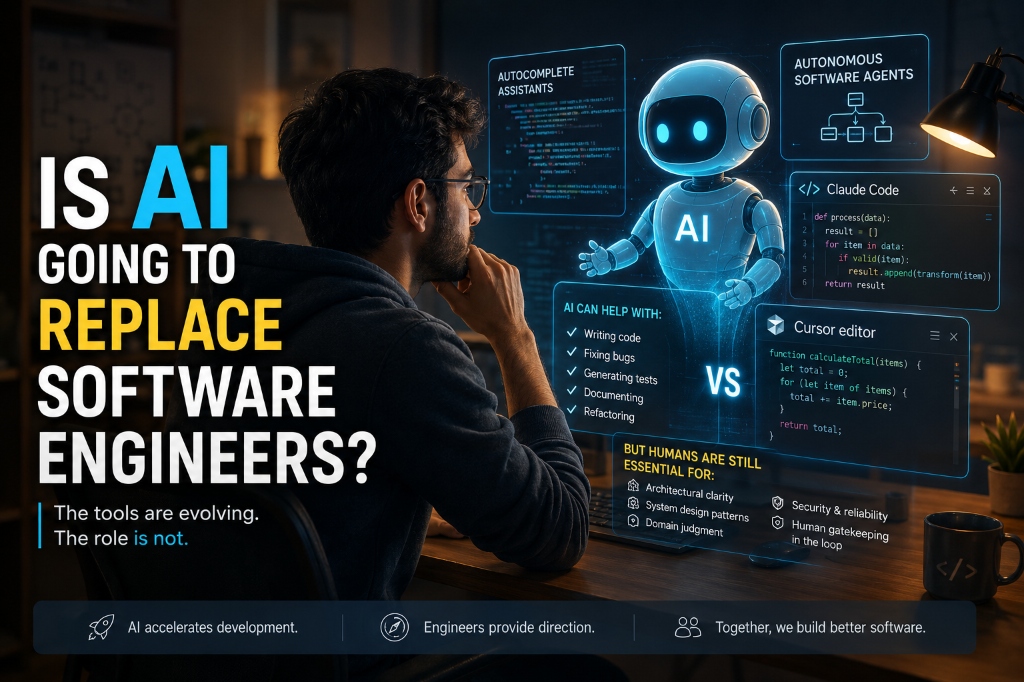
Is AI Going to Replace Software Engineers?
Is AI going to replace software engineers? Learn what AI coding tools can do, where they fail, and why software engineers still matter for architecture, security, and technical decisions.
If you’re wondering whether AI is going to replace software engineers, you’re not alone. AI can now write functions, fix bugs, explain code, create tests, and build parts of an application from a simple prompt. Tools such as Claude Code and Cursor editor can feel less like assistants and more like another developer sitting beside you.
So should software engineers be worried ?
Yes, but probably not for the reason you think.
AI is changing software engineering fast.It is reducing the amount of code humans need to write.But writing code has never been the whole job.The harder part is knowing what to build, why it should work that way, and what happens when things go wrong.
AI can write code.That changes the job.
For years, developers spent a lot of time writing code line by line.AI has changed that workflow.
Autocomplete assistants can suggest entire functions while you type.Coding agents can inspect a repository, modify several files, run tests, and suggest fixes.Claude Code and Cursor editor push this even further by letting developers work with AI across larger parts of a project.
That makes some tasks much faster.
A developer who once spent an hour writing a basic API endpoint may now produce a working version in minutes.The same applies to database queries, unit tests, documentation, configuration files, and repetitive refactoring.
But speed creates a strange problem.
When producing code becomes cheap, deciding which code should exist becomes more important.
Imagine giving a junior developer a machine that can produce ten times more code.You haven't suddenly created a senior engineer. You have created a junior engineer who can create ten times more code.
That distinction matters.
The evidence is more interesting than the hype
A July 2026 randomized controlled trial from Lund University, CodeScene, Equal Experts, and Dave Farley looked at exactly this question from a maintainability perspective.
The study involved 151 participants, with 95 percent being professional developers.In the first phase, developers added a feature to a Java web application with or without AI assistance.A separate group of developers then maintained the resulting code without AI assistance.
The AI assisted developers were between 30 percent and 55 percent faster when creating the initial code.
That sounds like a huge win for AI.
But there was a catch.
Researchers found no statistically significant difference in downstream maintainability between code created with AI and code created without AI.
The result suggests something important.AI can make a good developer faster, but it does not automatically make the resulting software better.
It also means AI can scale bad decisions just as easily as good ones.
The real problem is not bad code.It is plausible code.
One of the biggest risks with AI coding is not obvious nonsense.
It is code that looks right.
AI can produce hallucinations in code that pass a quick review.It can generate plausible but wrong syntax, use an outdated library method, misunderstand an API, or make an assumption about how your system works.
The code may even pass tests.
That does not mean the design is correct.
This becomes more dangerous as applications grow.A small mistake inside one function is easy to fix.A wrong assumption about authentication, data ownership, caching, networking, or service boundaries can spread through an entire system.
That is where AI induced technical debt starts to appear.
You save twenty minutes today and create three hours of debugging six months later.
And sometimes the cost is much higher.
Security is where human judgment still matters
AI can generate authentication code.It can suggest database permissions.It can write infrastructure configuration.It can even review code for security issues.
But software engineers still need to question the result.
Why ?
Because security isn't only about whether a line of code looks safe. It depends on context.
Who can access this service ?
What happens if a token leaks ?
Should this data exist in the first place ?

  What happens when this API receives unexpected input ?

    Can an attacker move from one service to another ?

      AI can help answer these questions.It cannot take responsibility for the consequences.
A developer who blindly accepts AI generated code can introduce security vulnerabilities without realizing it.
That is why human review becomes more important, not less.
Software engineering is bigger than coding
This is the part people often miss when they ask whether AI will replace developers.
A software engineer does much more than write code.
They make decisions about:
-
Architecture
-
Data flow
-
Infrastructure
-
Reliability
-
Security
-
Performance
-
Testing
-
Cost
-
Maintainability
-
Product requirements
AI can assist with each of these areas.But assistance is not the same as ownership.
Suppose a company wants to build a system that processes millions of documents.
AI can generate an API.
It can write a queue consumer.
It can create database models.
It can even suggest an AWS architecture.
But someone still needs architectural clarity.
Should the system use synchronous or asynchronous processing ? Where should retries happen ? What happens when a message is processed twice ? Which data belongs in a relational database ? Which workloads belong in object storage ? How should failures be monitored ?
Those decisions require context.
And context is where experienced engineers have an advantage.
System design becomes more valuable
As AI gets better at writing code, system design patterns become more important.
Think of coding as laying bricks.
AI is becoming very good at laying bricks.
But someone still needs to decide where the walls go.
A senior engineer understands tradeoffs.They know when a simple solution is better than a complex one.They know when to introduce a queue and when a normal API call is enough.They know when a microservice is useful and when it is just another operational headache.
This is domain judgment.
You don't get domain judgment by generating more code.
You build it by working on real systems, seeing failures, dealing with users, debugging production incidents, and learning why certain technical decisions age badly.
Will junior developers be affected ?
This is where the answer gets less comfortable.
AI will reduce the value of some entry level coding tasks.
If your entire job involves creating simple CRUD endpoints, writing basic tests, converting data formats, or making small frontend changes, AI can already handle a large part of that work.
That does not mean junior engineers become useless.
It means the path to becoming a strong engineer is changing.
A junior developer who uses AI as a teacher can progress faster.They can ask why a piece of code works, compare different approaches, inspect unfamiliar repositories, and learn from generated examples.
But a junior developer who accepts every AI suggestion without understanding it will struggle.
The difference is not whether you use AI.
The difference is whether you understand what AI gives you.
The future probably looks more like human gatekeeping
The most realistic future is not humans versus AI.
It is humans working with AI, with human gatekeeping in the loop.
An engineer gives the system a goal.AI generates possible solutions.The engineer reviews them, tests them, challenges assumptions, and decides what enters the production system.
That changes the engineer's role.
You may write fewer lines of code but spend more time reviewing architecture, defining constraints, checking security, debugging failures, and deciding between competing solutions.
In some teams, one engineer may supervise work that previously required several people.
That will affect hiring.
It will affect salaries.
And it will affect what companies expect from software engineers.
But it does not mean engineering disappears.
So, is AI going to replace software engineers ?
AI will replace some software engineering tasks.
It will automate parts of the job that are repetitive, predictable, and easy to verify.
It will also change how teams measure productivity.
But replacing the entire software engineer is a different problem.
Someone still needs to understand the business problem.Someone needs to make architectural decisions.Someone needs to investigate failures at 3 AM.Someone needs to decide whether a generated solution is safe enough for production.
And someone has to take responsibility when it isn't.
That person is still the engineer.
The engineers most at risk are not the ones who use AI.
They are the ones whose value depends only on typing code.
The engineers who understand systems, ask good questions, know their domain, and use AI as a force multiplier will remain valuable.
In fact, the gap between a strong engineer and a weak engineer may become wider.
AI makes coding cheaper.
Good judgment does not.